
The Objects That Know Him
A reader’s chamber note on name, oar, wax, scar, bow, bed, and door — the objects through which No Man Comes Home makes return more difficult than arrival.

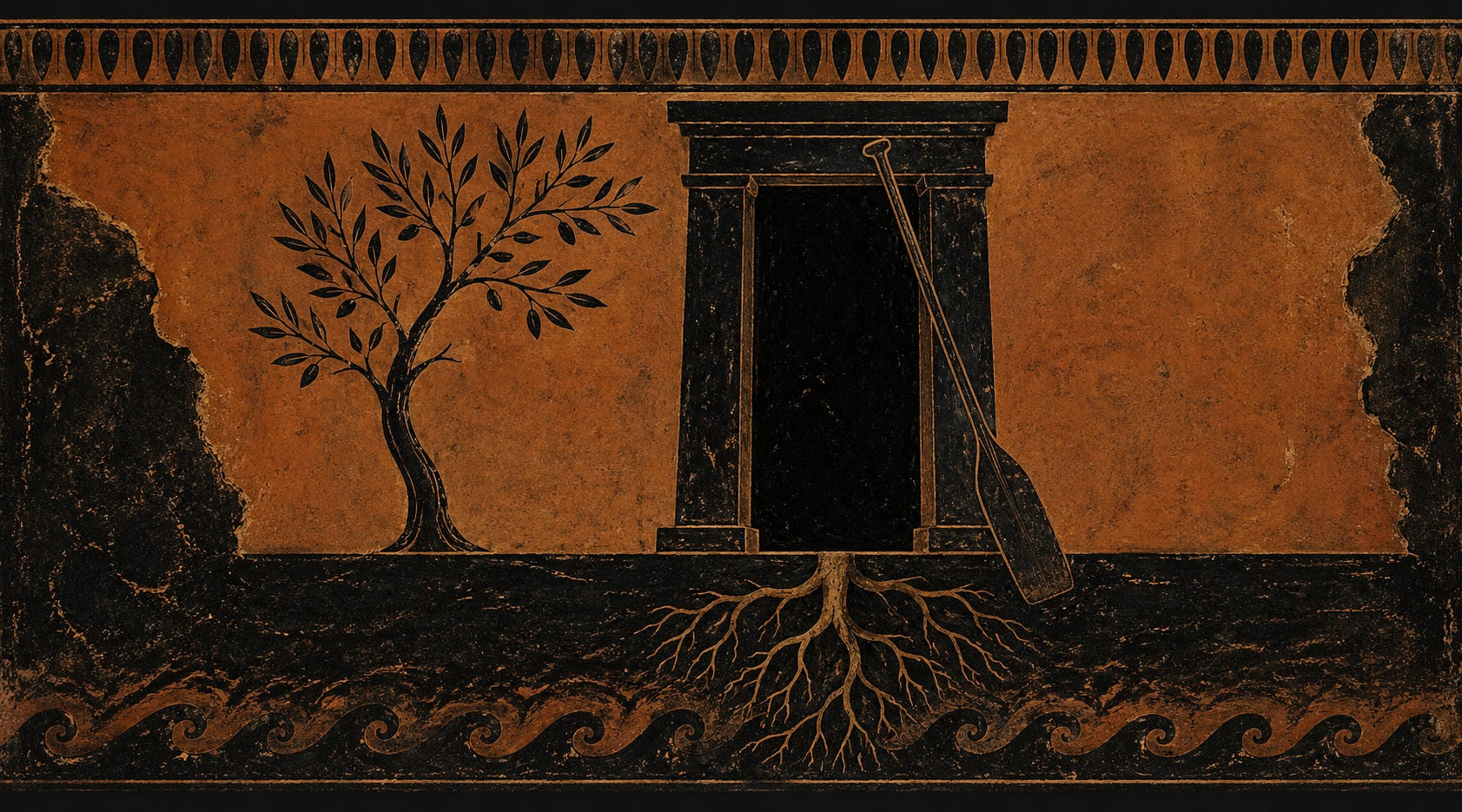
Odysseus has not yet reached Ithaca.
But the things that will judge him are already waiting.
Not men first.
Not speeches.
Not even the gods.
Things.
Name. Oar. Wax. Scar. Bow. Bed. Door.
The old story is crowded with marvels: the Cyclops, the enchantress, the dead, the Sirens, Scylla, Charybdis, gods moving through mist and command. But beneath those marvels runs a quieter authority. Objects keep knowledge differently from people. They do not admire. They do not forgive. They do not explain themselves into mercy. They answer only to use, touch, weight, memory, pressure, root.
In No Man Comes Home, the objects know Odysseus before the house can receive him.
This matters because the man approaching Ithaca is not simply lost.
He is concealed.
Survival has taught him the arts of withholding. He lowers the voice. He measures the listener. He gives one truth and hides another beneath it. He accepts disguise not as costume, but as shelter. He has learned that a revealed name may call down storm, that shared knowledge may break the rhythm of men at the oars, that tenderness offered too early may open the wrong door.
He is not merely a man who lies.
He is a man whom danger has educated into concealment.
That distinction is the moral chamber of the poem.
A lie may be vice, weapon, mercy, strategy, cowardice, intelligence, or delay. Concealment is larger. It is not only what speech hides. It is what the body learns when too much has depended on not being seen too quickly. A man may conceal from enemies. He may conceal from gods. He may conceal from servants, son, wife, father. He may conceal even from himself, not because he does not know the truth, but because truth, taken all at once, may be more than the hour can bear.
The name is the first great danger.
Inside the cave, Nobody is perfect. Nobody can slip through the grammar of the Cyclops’ world. Nobody can be harmed without calling help. Nobody can make truth useless in the mouths of those who hear it. It is not absence merely. It is absence sharpened into survival.
But the name will not remain buried.
Odysseus cries it from the ship because the self, saved too long by disappearance, hungers for witness. The cry is understandable. That does not make it innocent. It gives the sea a target. It teaches wrath where to find him. The name that restores him before the wounded Cyclops imperils every further road towards home.
Already the poem has made its bargain visible.
To be unnamed is safety.
To be known is danger.
The oar carries another law.
An oar is not heroic in the ordinary sense. It does not glitter in the hand. It is not carried into single combat. It does not receive songs easily. It belongs to repetition, to shoulders, to benches, to the long obedience by which men cross what would drown them.
That is why Tiresias gives it such strange authority.
The oar knows Odysseus not as king, husband, or hero, but as the source of rhythm in other bodies. It knows the cost of command before command has confessed itself. It knows that passage is never abstract. Someone rows. Someone bends. Someone bleeds at the hand. Someone obeys a knowledge he may never be given.
And one day, beyond Ithaca, beyond the bed, beyond the violence that seems to finish return, the oar must be carried inland until it is mistaken for a winnowing fan.
That mistake is not a joke in the prophecy.
It is a judgement.
The thing that belonged entirely to the sea must enter a country where the sea has no meaning. It must become illegible before its work is complete. In that future misrecognition, Odysseus is shown the condition of his own return: the life that made him must be carried into a place that cannot read it. Home, too, may look at him and fail to understand what it sees.
Then comes the wax.
It is ordinary, almost tender: bee-labour, softened by the hand, pressed carefully into the ears of men who trust him. Its smallness makes it severe. The wax is not a monster. It is not divine flame. It is not the voice of prophecy. It is the substance by which knowledge is divided.
The men row.
The captain hears.
The men are spared.
The captain is marked.
This is command at its most intimate and most troubling. He touches each man near the face. He seals them against what would destroy them. He cares for them by excluding them. Then he stands bound above them, receiving the Sirens’ knowledge while their bodies keep the ship moving through what they cannot hear.
After Scylla, the division deepens. Some men die under a knowledge never fully given to them. Others survive under the same authority. Odysseus continues, carrying song beside death.
The wax has done its work.
It has shown that concealment is not always selfish. It may be protective. It may even be necessary. But necessity does not cleanse it. The hidden knowledge still has weight. The men who obey may never know what their obedience cost, or what it spared them.
After this, return can no longer be imagined as a bright reversal of wandering.
It will be the arrival of a man trained by unequal knowledge.
The Ithaca cantos, therefore, cannot simply recognise him.
They must test the forms by which recognition becomes possible.
The scar will know before the wife is ready.
The bow will know before the hall can bear the answer.
The bed will know what fame cannot prove.
The door will wait until all proofs have shown their limits.
The scar belongs to the body’s involuntary history. It lies under disguise, under age, under rags, under the carefully managed beggar-shape. It does not argue. It does not persuade. It is found by touch. Eurycleia’s hands, which knew the child before the man became story, discover what speech is still forbidden to reveal.
The scar proves continuity.
That is not enough.
The bow proves use.
It knows the hand not as memory only, but as capacity. Men may claim the house, eat its wealth, court its queen, sit in its hall, speak in its forms. They may even believe duration has made them legitimate. But the bow does not recognise appetite. It recognises the body that can make it answer.
The bow proves force.
That is not enough either.
The bed waits deeper.
It does not prove that Odysseus has returned unchanged. Nothing could prove that, because it is not true. The bed proves that the man before Penelope once entered the secret architecture of their life together. He made the room around the rooted olive. He knows what cannot be moved because he built the marriage around it before war and absence remade them both.
The bed proves original union.
Even that is not peace.
The door remains.
The door is the final object because it is not only an entrance. It is the boundary between strategy and recognisability. A man may pass through many thresholds by cunning: cave, island, palace, hut, hall, chamber. But the last door cannot be crossed by concealment alone.
It requires being known.
And being known is precisely what survival has made difficult.
This is why the final cantos must be harder than the wandering cantos.
The sea tests endurance.
The house tests legibility.
A monster can be deceived. A goddess can be refused. A song can be survived by rope. A whirlpool can be avoided at terrible cost. But a wife who has waited without becoming foolish cannot be entered as another danger to be managed. A son cannot be restored by command alone. A father cannot be approached forever through another fiction. A house cannot be cleansed merely because the enemies are dead.
The old objects will help him.
They will also expose him.
That is their mercy.
They do not flatter the hero. They do not ask whether the story would prefer him splendid. They hold what speech would distort. They answer only to use, touch, root, scent, memory, weight. They strip the adventure down to forms older than explanation.
A dog will know by scent.
A nurse by scar.
A bow by use.
A wife by bed.
A father by trees.
The island by blood.
And still, after all this knowing, no proof will be large enough to make return simple.
That is the severity of the poem.
Odysseus has not survived in order to arrive unchanged before those who love him. He has survived in order to arrive altered, carrying the very arts that must now be judged, received, restrained, and slowly made answerable to the life he wanted back.
The first eight cantos bring him to the edge of Ithaca.
The last four ask whether arrival can become return.
Not quickly.
Not cleanly.
Not by name alone.
The objects are waiting.
They know more than anyone is ready to say.
No Man Comes Home is a twelve-canto literary retelling of The Odyssey within The House of Cadmus: a poem of return, concealment, recognition, and the cost of surviving long enough to come home.